
What to See in Perugia in Half a Day: 5 Must-See Places
5 Things You Shouldn't Miss in Perugia in Half a Day
Perugia is a city that surprises you at every turn. Perched on a hill in the heart of Umbria, its historic centre is home to medieval palaces, ancient gates, monumental squares and important remains of the Etruscan civilization. Even if you only have half a day, you can discover some of the city's most remarkable landmarks and experience its history, art and atmosphere.
Walking through Perugia means travelling across centuries of history, from its Etruscan origins to its medieval architecture and Renaissance heritage. The historic centre is relatively compact, and many of the main attractions are within walking distance of one another, making it possible to explore the city on foot in around three to four hours.
If you are planning a visit and wondering what to see in Perugia in half a day, here are five places you shouldn't miss to discover the authentic character of Umbria's regional capital.
1. Piazza IV Novembre and the Fontana Maggiore
The ideal starting point for exploring Perugia is Piazza IV Novembre, the city's historic and monumental heart. Some of the most important and impressive buildings in the historic centre are located here, creating an architectural setting that reflects the prestige of Perugia during the Middle Ages.
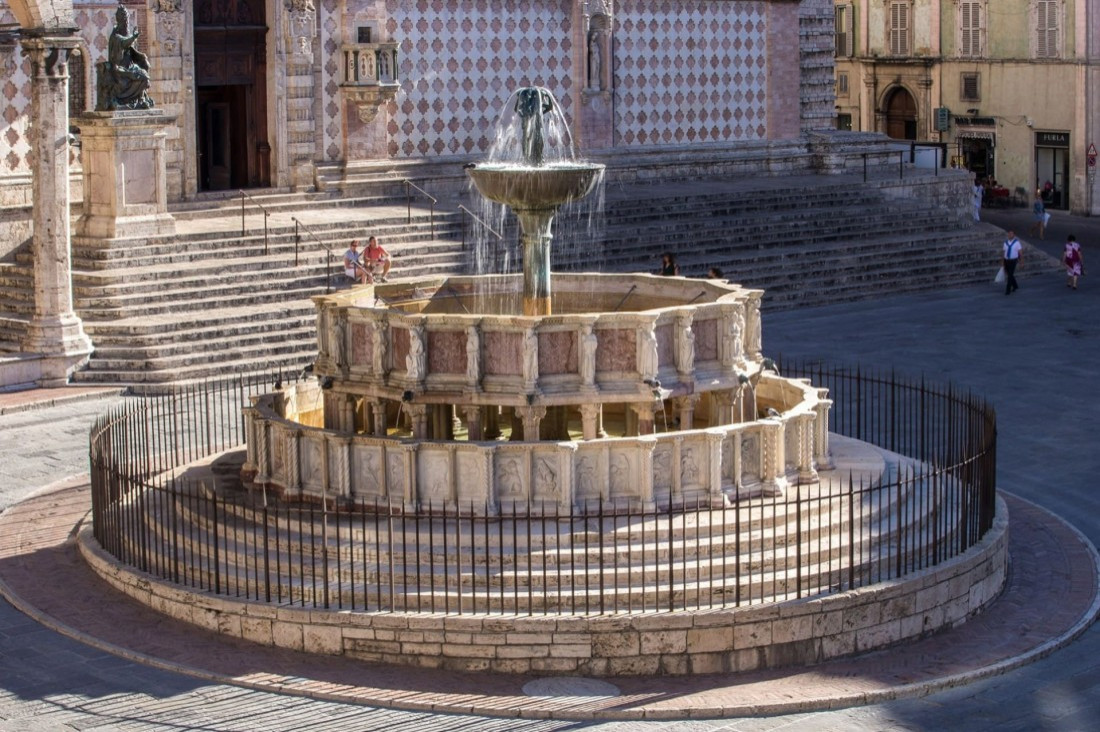
At the centre of the square stands the famous Fontana Maggiore, built between 1277 and 1278 by sculptors Nicola and Giovanni Pisano. It is one of the masterpieces of medieval Italian sculpture and one of Perugia's most important attractions.
The fountain consists of two overlapping basins decorated with numerous bas-reliefs and statues. Their scenes depict biblical episodes, everyday life, the months of the year, arts and crafts, as well as figures from ancient history. Looking closely at the decorations reveals a remarkable story carved in stone, offering a glimpse into the culture and society of the 13th century.
The square is also dominated by Palazzo dei Priori and the Cathedral of San Lorenzo. Take a few minutes to admire the entire architectural setting: it is one of the best places to begin discovering Perugia's history and identity.
2. Palazzo dei Priori and the National Gallery of Umbria
Overlooking Piazza IV Novembre, Palazzo dei Priori is one of the city's most important medieval buildings. Construction began towards the end of the 13th century, when it served as the seat of political power for the free commune of Perugia. Today, it still retains the impressive character of a great medieval civic building.
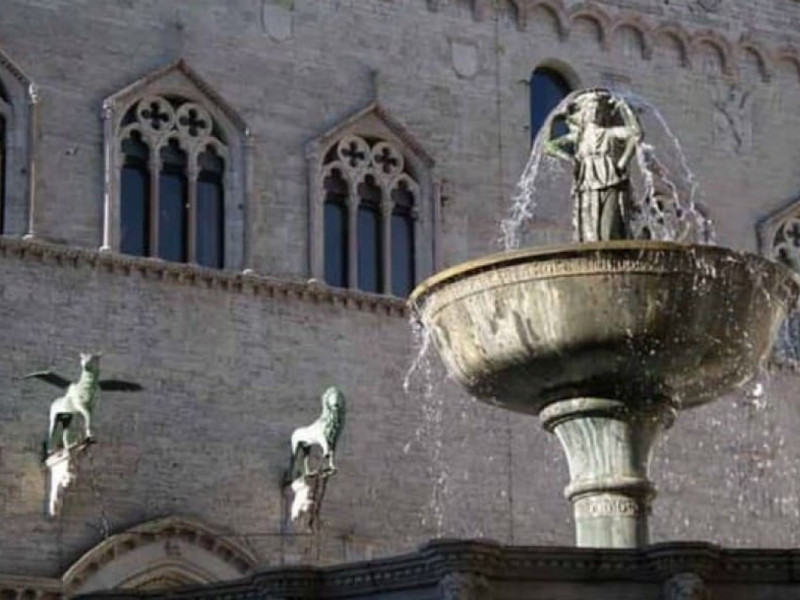
Its Gothic façade, monumental entrance and stone decorations are among its most distinctive architectural features. The griffin of Perugia and the lion, two historic symbols of the city, can also be seen on the façade.
Inside the palace is the National Gallery of Umbria, one of the most important art museums in central Italy. Its collections trace the history of regional art over several centuries, from the Middle Ages to the Renaissance, featuring works by major artists such as Beato Angelico, Piero della Francesca, Perugino and Pinturicchio.
If you only have half a day, you can choose to visit some of the museum's main rooms, allowing around one hour for the visit. If you would rather focus on exploring the historic centre, the palace is still worth admiring from the outside.
3. The Cathedral of San Lorenzo
On the northern side of Piazza IV Novembre stands the Cathedral of San Lorenzo, Perugia's main religious building.
Construction began in the 14th century and continued over several decades. One of the cathedral's most distinctive features is its side façade, which faces directly onto the square, while the unfinished main façade overlooks Piazza Danti.
The interior is impressive, with side chapels, decorative features and works of art that reflect the city's long religious history.
Among the most interesting details to look out for are the stained-glass windows, frescoes and artworks housed in the chapels. The cathedral also preserves important relics and objects connected with local devotion, including the Holy Ring, traditionally identified as the wedding ring of the Virgin Mary.
Visiting the cathedral offers an opportunity to discover another essential aspect of Perugia's history, closely connected with religious life and the traditions of the local community.
4. The Etruscan Arch and Perugia's Ancient Origins
To truly understand Perugia's history, you need to travel back more than two thousand years, to the Etruscan period.
The Etruscan Arch, also known as Porta Augusta, is one of the most significant surviving sections of the city's ancient walls. Located in the northern part of the historic centre, it was one of the main monumental entrances to ancient Perugia.
Probably built in the 3rd century BC, the arch features an imposing structure made of large blocks of travertine stone. It was later modified by the Romans, as shown by some of the inscriptions and decorative elements that can still be seen today.
The gateway is an important link between Etruscan and medieval Perugia, showing how the city has preserved traces of different historical periods within its urban landscape.
Walking to the Etruscan Arch also takes you away from some of the busiest streets, allowing you to discover a quieter part of the historic centre, with charming views and ancient buildings.
If you have time, you can continue towards the University for Foreigners and Piazza Fortebraccio, an interesting area for discovering the city's academic and cultural atmosphere.
5. Corso Vannucci and Rocca Paolina
After exploring Perugia's main historic landmarks, a walk along Corso Vannucci, the city's main street, is a must.
It is the perfect place to experience the atmosphere of Perugia. Historic cafés, shops, elegant buildings and restaurants line this attractive pedestrian street, which connects Piazza IV Novembre with Piazza Italia.
The street is named after the painter Pietro Vannucci, better known as Perugino, one of the leading figures of the Italian Renaissance and a teacher of Raphael.
From here, you can reach Rocca Paolina, one of Perugia's most unusual attractions. This fortress was built in the 16th century at the request of Pope Paul III Farnese, following the city's submission to the Papal States.
The original structure was an extensive fortified complex that incorporated medieval buildings and streets. Today, some of its underground areas are open to visitors. The route takes you through ancient streets, arches and the remains of buildings that were incorporated into the fortress.
Rocca Paolina is one of the city's most fascinating places because it allows visitors to see first-hand how Perugia's history has developed and accumulated over the centuries.
You can end your walk in Piazza Italia, which also offers beautiful views over the Umbrian valley.
What to Eat in Perugia During a Short Visit
Even if you only have a few hours, it is worth taking a break to sample some local specialities.
Perugia is famous worldwide for its chocolate, thanks to the city's long confectionery tradition and the presence of major chocolate manufacturers. Among its best-known products are Baci Perugina, which have become one of the gastronomic symbols of the Umbrian capital.
But Perugian cuisine has much more to offer: torta al testo, local cured meats and cheeses, traditional Umbrian pasta dishes and regional desserts.
If you have time for a break, stop at one of the cafés or restaurants in the historic centre for a coffee, an aperitif or a tasting of local products.
Discover Perugia with a Local Tour Guide
If you only have half a day, exploring the city with a local tour guide can be the best way to discover Perugia without wasting time or missing its most important landmarks.
As you walk through squares, palaces and ancient streets, an experienced guide can tell you about the Etruscans, the history of the medieval free commune, rivalries between noble families and the city's transformation under papal rule.
A guided visit is not simply about seeing monuments. It is about understanding the historical and cultural significance of the places around you.
A guided tour is particularly suitable for first-time visitors, families and small groups who want to make the most of their time in Perugia.
Perugia in Half a Day: Our Recommended Walking Itinerary
To explore Perugia's main attractions in approximately three to four hours, we recommend the following walking itinerary:
Piazza IV Novembre: Start at the Fontana Maggiore and admire the monumental heart of the city.
Palazzo dei Priori: Discover one of Perugia's most important medieval buildings and, if time allows, visit the National Gallery of Umbria.
Cathedral of San Lorenzo: Step inside the city's main church and discover its artworks and traditions.
Etruscan Arch: Visit one of the most important surviving landmarks from Perugia's ancient past.
Corso Vannucci and Rocca Paolina: End your visit with a stroll along the city's main street and explore the fascinating underground areas of the fortress.
This itinerary allows you to discover some of Perugia's most representative landmarks without covering excessive distances.
Perugia is a city rich in history, art and traditions, and even a few hours are enough to appreciate its charm. But if you really want to get to know it, take the time to listen to the stories behind its monuments and let someone who knows the area guide you through its streets.
Share